
Hey there! I'm Jasper!
I'm a Game Designer with 4 years of industry experience making games!
I create memorable and engaging player experiences through rich systems, satisfying loops, and immersive storytelling.I am highly proficient with many industry-standard tools and practices, and I have a lot of experience with rapid prototyping. For me, it's all about testing and improving an idea until it's polished like a fine diamond.As a generalist, I am always looking to take on new challenges! I am an excellent collaborator, and can work in cross-disciplinary teams.
Halfbrick Studios
Game Designer
July 2022 - Mar 2026

Sheridan College
H. Bachelor of Game Design
September 2018 - April 2022



Design, Code, QA
2023/09 - 2026/03
A puzzle-adventure game that I worked on from its conception to its release. I contributed to most of the overall game design and gameplay.







Bluey's Quest for the Gold Pen
My Contribution
Throughout the production, I designed, prototyped and implemented:
- core mechanics
- core systems (core loop)
- game content (obstacles, collectables, quests/NPCs)I was involved in the full production pipeline for the game, from the start of concepting to the final shipped build.While I was primarily worked on the game design, I was also responsible for other areas of its development, including programming and QA.
Mechanics
My Contribution
I was responsible for creating the core game mechanics. This includes design, prototyping, iteration, associated obstacles, implementation, and testing.My work resulted in a variety of innovative and engaging core mechanics, with each mechanic having a large amount of associated gameplay to support it.
My Design Process for Mechanics
This is a simplified version of the design workflow I used to create the game's mechanics (this is just a rough outline, having regular feedback and new discoveries means that development isn't linear):1) I start with rapid prototyping to create a wide variety of playable prototypes, either paper prototypes or in-engine prototypes depending on the idea. I also create a few basic obstacles to show off the mechanic.2) After the mechanics are tested, I review feedback to figure out what works and what needs improvement.3) Once a mechanic shows promise, I explore different variations of the mechanic, finding the best version of it.4) With the improved version of the mechanic, I start tuning the mechanic. I create test levels to get the metrics and game feel right.5) Then I explore gimmicks/obstacles related to that mechanic, creating a breadth of meaningful gameplay using just that mechanic alone.6) Finally, I take the mechanic and search for interactions with other mechanics, combining them to vastly expand the variety of gameplay with only a handful of mechanic.
Example: Magic Wand
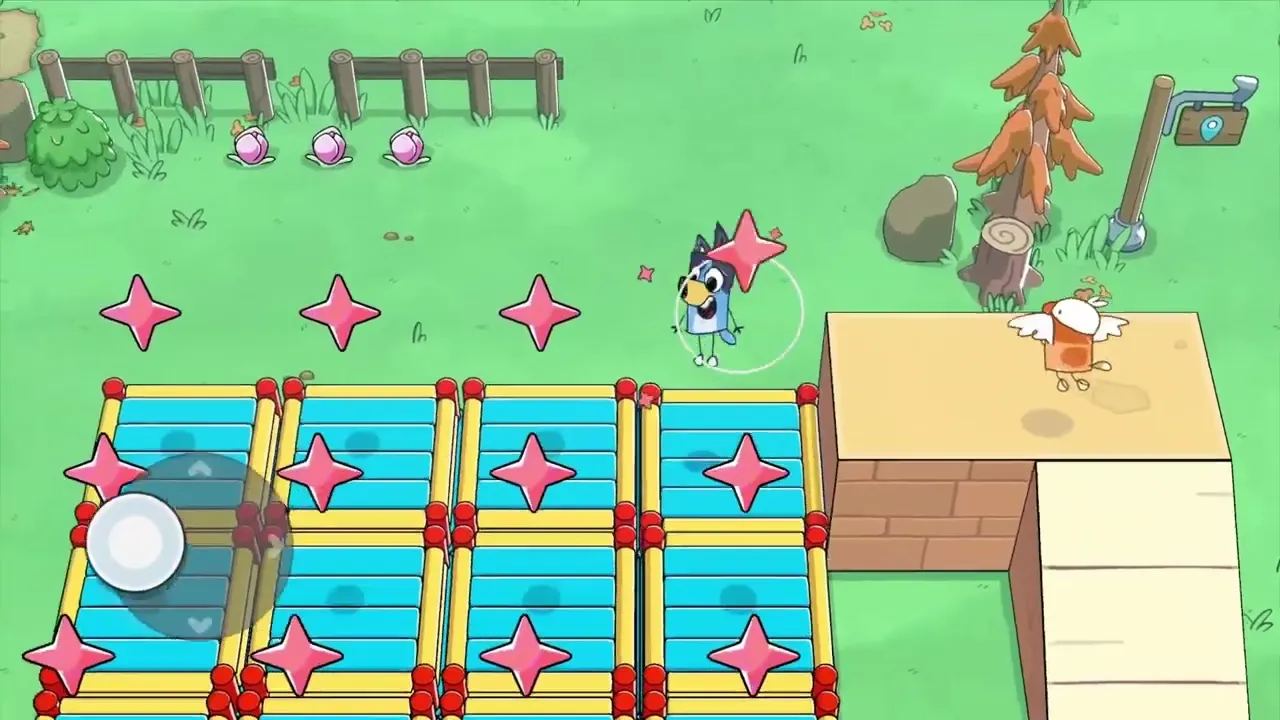
The main mechanic of the game is the Magic Wand ability, which allows the player to grab onto certain blocks and move them around, among other things.1) I initially started with a grapple prototype, similar to a lasso. I created a few blocks that the player could grab onto and drag around.2) The constraint around the player's movement (the player drags the block around, meaning that they have to step onto wherever they want the block to go) started to limit uses for the mechanic.3) After several iterations, I worked on a version of the grapple mechanic where the player is tethered to the object instead, which opened the door for a wide variety of obstacles to be designed.4) I created a test gym for the mechanic, and worked on getting the grapple feeling intuitive and easy to design around. This included a lot of physics considerations, as well as the length that the player could grapple from.5) I then explored a lot of different gimmicks and obstacles for the grapple. These included a Zelda-style hookshot, blocks that had special geometry, and blocks that could be rotated or extended using the grapple. I set up test gyms for these gimmicks/obstacles, and explored different ways they could be used.6) I started combining the grapple ability with the throw ability, and discovered that the two are very similar in input and base function. This led to the two abilities being merged together into an "Aim" mechanic, which became the Magic Wand.
Systems
My Contribution
ADD
Finding the Core Loop
Because I was part of the initial team working on the game, I had to work out what the game's core loop would be while many aspects of the game were still being figured out.I used a combination of Miro and Unity to explore early prototypes of the core gameplay, which eventually led to a 3D adventure game setup with an emphasis on platforming and puzzles.
Content: Obstacles
My Contribution
I was responsible for creating a catalogue of challenge areas (parts of a level that revolve around an obstacle or mechanic). These were then taken by the level designers and placed in levels.My work resulted in a large amount of engaging play spaces, which are the main component of the game's levels.
My Design Process for Challenge Areas
This is a simplified version of the design workflow I used to create the game's challenge areas (specifically the more action-oriented ones):1) I first write down every unique player input related to a mechanic/set of mechanics.2) Then I create a list of every permutation of those inputs.3) I make a new test level and quickly create layouts that require those inputs to successfully complete.4) From there, I test each layout, and make a note of which ones stand out.5) Then I create a sequence of the best/most harmonious layouts. I arrange them using the order of "Teach, Test, Challenge". (Teach: introduce the obstacle individually with low stakes. Test: present the obstacle at a higher level of difficulty/danger. Challenge: make the obstacle more complex or add a twist).6) Finally, I iterate upon the sequence, incorporate feedback and improve the experience.
Example: Glider Challenge Areas
ADD
Content: General
Collectables
I was responsible for creating a bunch of collectable objects, as well as prototyping ways that they could be hidden throughout the levels.Dig mechanic.
Invisible coins.
Quests & NPCs
I was responsible for implementing and iterating upon the game's quests. I created resources and documentation to track all of the quest information. I worked on adjusting quest layouts, quest progression, and the locations of the quests/requirements/NPCs involved. I was responsible for determining which quest types should be active in which zone.I was responsible for implementing the various NPCs. I worked on the placement of the NPCs within the levels.
Other
Documentation
I contributed to the documentation of many aspects of the game. I wrote clear, concise, and understandable information over Confluence and Miro.Some examples include:
- high-level overviews of how the game's systems work from a gameplay perspective.
- practical guides on how to implement content in-game (for those on the team with less technical experience).
- charts detailing the locations of collectables, NPCs, and quests.
- visual guides for the fastest routes to complete the game (to help QA test later levels).
Programming
I contributed to/assisted with numerous programming tasks, including:
- core gameplay mechanics
- various gimmicks/obstacles
- quest system
- NPC/interactable systemI also created a tool to help level designers place objects in-engine.
Implementation
ADDVarious UI screens (designing for Mobile/PC/Consoles)
Credits


Mechanics
Environments
Design, Code, QA
2022/08 - 2023/09
An enhanced version of the original Fruit Ninja. I worked on LiveOps for the game, creating new gameplay abilities and seasonal in-game events.


Fruit Ninja Classic+
My Contribution
ADD
Content: Abilities
My Contribution
ADD
Blade Powers (Abilities)
ADD
Content: Events
My Contribution
ADD
In-Game Events
ADD
Other
Programming
ADD
Implementation
ADDUI Screens
UX
QA
Followed a QA Checklist.
Reported and documented issues on Miro & Jira. Included build number, repro steps, and expected behaviour with each report.


Code, QA
2023/04 - 2023/09
A port of Fruit Ninja Classic+, I contributed to the implementation of various backend functionalities and SDKs, as well as the relevant QA.




Code
2023/05 - 2023/06
I worked on the initial port of the game into Unity, working primarily on the UI and game feel.




Code
2022/07 - 2022/08
I worked on the initial port of the game into Unity, working primarily on the scoring systems and game feel.




Design, Code
2021/09 - 2022/04
Student capstone project (team of 5). Designed the systems and core loop. Primarily did most of the programming. Showcased at XP Game Summit.




Design, Code
2021/03
Student game jam (team of 7, one week). Designed the detection system, core loop, and hiding locations. Primarily did most of the programming.




Design, Art
2020/11
Student game jam (team of 12, one week). Designed the core loop, power-up system, and power-ups. Created art for the power-ups.



Design, Code
2020/10
Student game jam (team of 4, one week). Designed the core loop and the launch system. Programmed the launch ability and most systems.




Design, Code, Story
2019/01 - 2019/04
Student project (team of 4). Designed the first level. Worked on the narrative. Programmed the character controller and most of the code.